Ahead on Differential

UR

FUCK YEAH DUDE

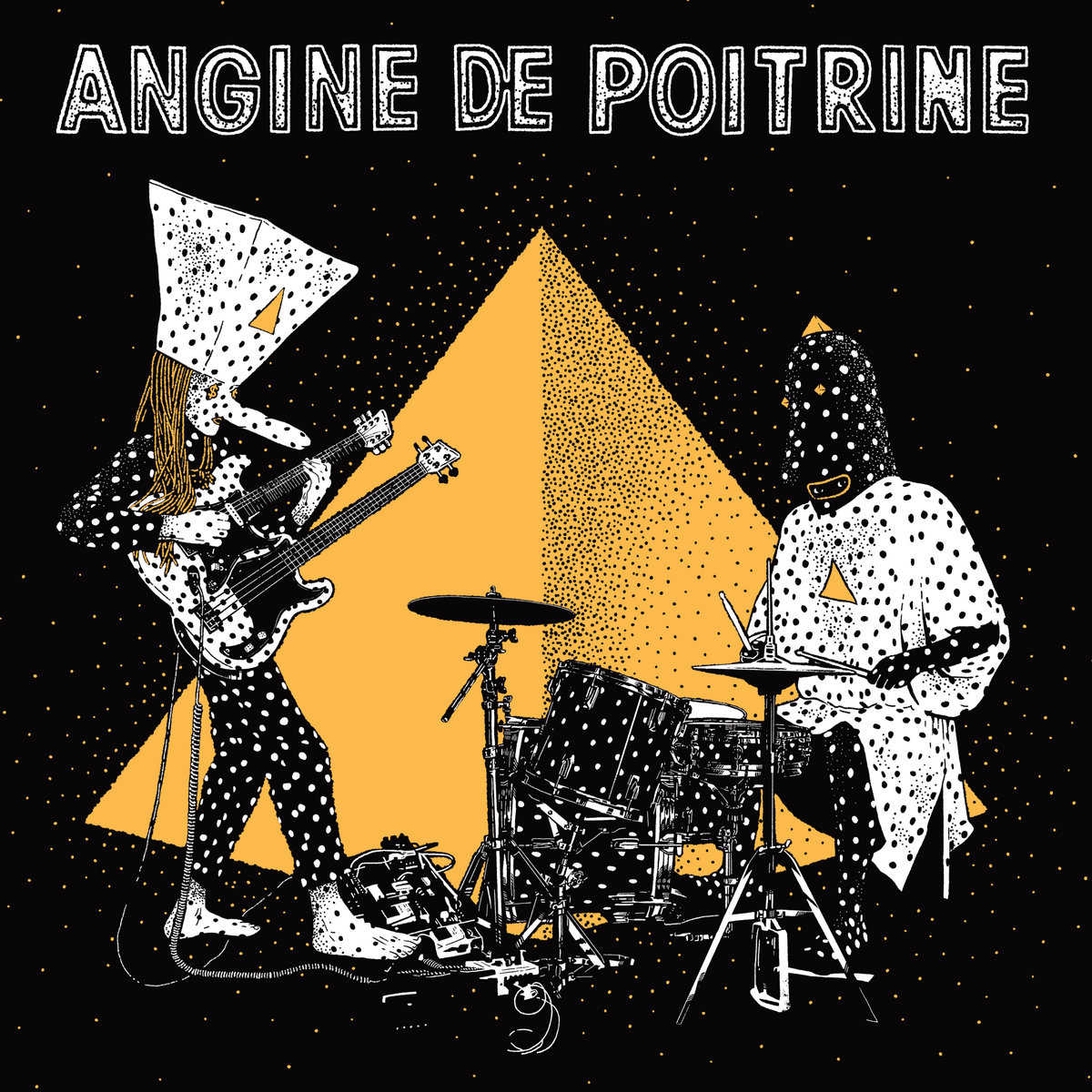
Like most of the world, I first encountered math-rock duo Angine de Poitrine (French for angina pectoris) in my YouTube subscription feed. On February 5th, the venerable Seattle radio station KEXP premiered a four-song, 28-minute set by the band, recorded two months prior as part of the Trans Musicales festival in Rennes, France. The performance has since gone turbo-viral (8.8 million views at time of writing) in a way videos of rock bands don’t usually go. There’s a you-gotta-see-this novelty to the group that’s evident even before they start playing: the costumes, the polka dots, the voice filters, the double-neck guitar, the wordmark set in the Twin Peaks font, the conspiracy theorist-baiting triangle imagery. We haven’t even gotten into the band’s kayfabe lore yet. What kind of wackadoo art project am I about to listen to?

Then the Poitrine brothers, Khn on guitar and Klek on drums (the duo wishes to remain anonymous, Residents-style), kick into “Sarniezz,” the third track on their then-upcoming second record. Don’t even try to buy a physical copy of it now, it’s perpetually out of print, that’s how turbo-viral these guys have gone (but by all means cop the digital version). Once the rhythmic scaffolding of “Sarniezz” is built, Khn loops and layers microtonal guitar licks until the song morphs from a woozy post-punk shuffle into a double-time pit opener. That’s part of the Angine de Poitrine magic: their sound—microtonal guitar and bass, drums, loop station—is as versatile as it is minimal. They establish a melodic baseline, iterate on it for a while, take a dynamic left turn somewhere along the way, then fold the streams into each other. What impresses me most when I see these guys perform is Khn’s live editing of the song currently being played: which loops are recorded when, when to mute them and bring them back in, and when to override them, all done while playing two guitars that have twice as many frets as usual, usually in uncommon time. It’s a feat of rare mental, physical, and musical dexterity.

But all the technical proficiency and visual gimmickry in the world wouldn’t matter if the songs weren’t any good. Friends, these songs are good. Listening to this band is fun as hell. “Mata Zyklek,” another Vol. II track featured in the band’s KEXP set, is a “Rock Lobster”-esque surf-punk number fit for a monster movie. Vol. II’s standout may well be “Utzp,” the first song on the album not performed in the KEXP set. What begins as a jaunty country polka slowly mutates into a thrash-metal face-melter worthy of Headbangers Ball. Elsewhere on the album, I hear their brothers in microtonality King Gizzard and the Lizard Wizard, Brain-era Primus, Pitchfork Hall of Famers Battles (remember 2007?), 80s King Crimson, fellow Saguenay space cases Voivod, and any number of bands that put records out on Touch and Go in the 90s. Imagine a happy Shellac. Imagine Polvo having a crack at a dancefloor classic. Imagine Don Caballero scoring a sci-fi spaghetti western.

In the weeks since becoming the most viral band on the planet, Angine de Poitrine have been booked and busy: their first shows in English Canada and the United States are slated for the summer, followed by a European tour and a smattering of shows at home, including a tour-ending two-night stand at Montréal’s legendary Club Soda in November. They’re on the bill at Fuji Rock and King Gizz’s Field of Vision festival. This success is to be celebrated. Angine de Poitrine is an algorithmic aberration. They are a pop of colour contrasting the usual griege mush the feed prefers, which is ironic considering their colour scheme. I love this band, long may they run! But fellas, please, I need you to press some CDs for the old heads out there.

#UR

The beseechings of the coolest cinephile you know and the biggest comedy dork you know (who may well be the same person, honestly) are fully warranted: Nirvanna the Band the Show the Movie, the cinematic offshoot of Matt Johnson and Jay McCarroll’s gonzo metafictional mockumentary Viceland series, is the comedy event of the year, possibly of the century, certainly north of the 49th parallel. You needn’t have seen any prior iteration of the project to get it; the stakes, such as they are, are secondary to the shenanigans they generate (and rest assured, shenanigans are generated). You needn’t have seen any of Johnson’s prior directorial efforts, including BlackBerry, which I described to friends as “The Social Network’s dorky Canadian cousin” (Glenn Howerton’s bald cap is maybe the ninth-funniest thing in that movie; this is a compliment). You needn’t have seen or heard Johnson charming his way though every movie and/or comedy podcast worth listening to, bantering with great candor and enthusiasm, talking shop and future projects with the endearing sugar-rush intensity of a birthday boy buzzing in his seat post-cake, pre-presents.

What you do need to know, because the premise of these little blurblets is that I’m trying to sell you on things, is that Nirvanna the Band the Show the Movie is a synapse-frying stew of Mike Schur comedies, guerilla filmmaking, social engineering, post-production wizardry, guileless improv, flagrant copyright trolling, inspired stupidity, and a dollop of edgelord shock to taste, all in the service of what Back the the Future would look like if it were sweded by a couple of ding-dongs on the streets of Toronto over the course of nearly 20 years. It’s as if someone took all that un-white balanced mini-DV camera footage you shot with your friends, where every interior looks like it has smoker’s cough and every exterior is blown out by the Sun, and stitched it into a video installation about those very friendships. It’s as if… man, it’s a miracle this film’s budget wasn’t spent primarily on paying fines, that’s what we’re dealing with here.

#UR

I’m not sure where I was first tipped to the existence of Samuel, Émilie Tronche’s cute, charming series of slice-of-life shorts featuring a mopey French tween. Who am I kidding, it was likely in an industry rag that ran the announcement that Netflix had bought the American distribution rights and translated to English; there was maybe a time in my life where I would have been hip enough to have caught this on Arte, the Franco-German state TV channel where the shorts were first aired, but that’s not me now. I’m just a guy mooching off his mom’s Netflix account.

Tronche’s art style reminds of a lot of the work of Jeffrey Brown, the Chicago-via-Michigan cartoonist best known for his cycle of melancholy diary-comic memoirs from 2002-2005 (further Derek Lore: I was a big autobiographical graphic novel guy in college: Brown, Craig Thompson, Lucy Knisley, et al.). There’s more than a little Bryan Lee O’Malley in there as well, what with the big eyes and manga-like flourishes. It’s all pretty scratchy and spare, but Samuel, his friends, and their shenanigans are so well-written that it doesn’t register as twee affect. That’s the power of strong characters and a good story.

It’s also very well animated: there’s a tag scene early on that as dynamic a visual sequence I’ve seen in a recent cartoon. Even though the show is strongest in moments of stillness, where little more than a character’s eyes move, there are some bravura sequences across the 21 episodes. There are multiple show-stopping dance numbers, which are very fun as rendered in this style, and made that much cool if you know that Tronche is a former dancer.

Samuel also includes the best use of the thoroughly memory-holed Top 20 hit “Fuck It (I Don’t Want You Back)” by Eamon. Remember Eamon? I wonder what’s he’s up to these days. There’s lots of actually good music used/referenced in the show, too; dig this fan-curated playlist.

If you, like me, speak French, I implore you to seek out the original French-French dub; bust out the VPN if you have to. If you’ll settle for a Québecois dub, Télé-Quebec has you covered. If English is your only course of action, give your mom a call and ask her for the Netflix password.

#UR